
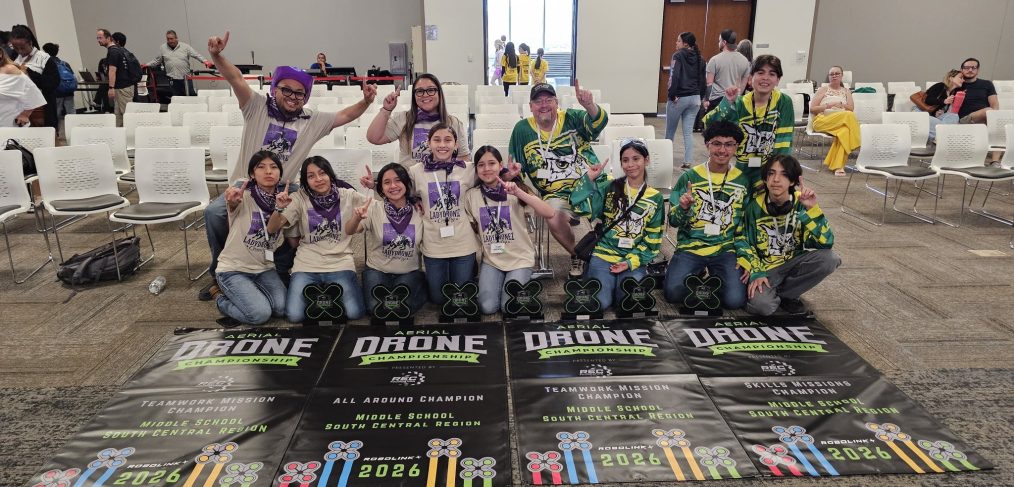
When two third graders asked Patricia Cortez, Texas history teacher at the School for the Talented and Gifted in Pleasant Grove, to start an all-girls robotics team, she said no.
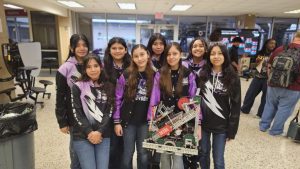
The school’s robotics team just returned from the VEX World Championship. The team had trophies, momentum, and a winning formula. The girls on the team, however, did not feel like they were fully participating in the experience.
“They told me they felt intimidated,” Cortez said. “They said they wanted their own team where they could take on bigger roles.”
Cortez heard them, but she hesitated because of her lack of background in the field.
“I have no engineering background,” she said. “I knew nothing about robotics. I love math, but not programming. I’m very competitive, so in my head I was thinking, iIf we do this on our own and lose, what happens then?’ So I told them no.”
The students didn’t drop it. Instead, they gave Cortez back her own words.
“They said, ‘if this is all about learning, then you can learn with us. Let’s do it together,’” Cortez said. “That stopped me. They weren’t asking for an easy path. They were asking for a chance.”
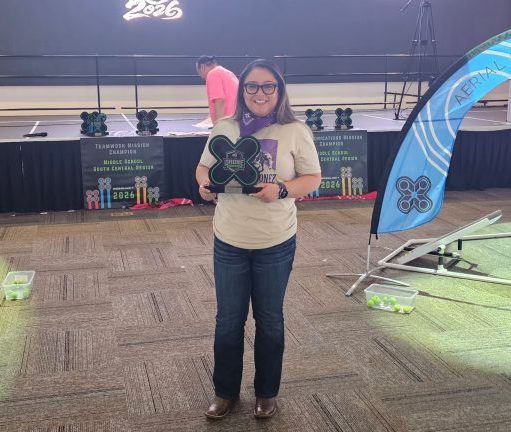
That conversation became the starting point for the LadyBots, an all-girls robotics team that since g
rew into a larger web of STEM opportunities at TAG: LadyDronez, an all-girl aerial drone team, and Girls and Gears, a workshop hosted by students to introduce younger girls to STEM activities.
Cortez has been with Dallas ISD for 13 years.
She began teaching at Casa View Elementary School, the same campus she attended as a child, and later moved to TAG in Pleasant Grove. Robotics, however, was not part of her original plan. It arrived as a district initiative to expand STEM offerings. A colleague asked if she would co-coach.
Once the Lady Bots formed, Cortez began looking more closely at who is usually seen in STEM spaces.
“I started reading about how underrepresented women are in STEM, specifically Latinas,” Cortez said. “When I shared those statistics with my girls, it really hit them. It made them want to keep the Lady Bots going and bring more girls in.”
Cortez admits that STEM even forced her to confront her own habits.
“As a child, I was a perfectionist. I had to accept that I’m not going to get everything right the first time and that nothing is ever really perfect,” she said. “Robotics taught me to embrace failure. Once I learned that for myself, it was easier to tell my students, ‘It’s okay to get things wrong. In STEM, that is how you learn.’”
One student’s growth in particular stays with Cortez. At her first drone competition, the student froze when Cortez asked her to shout to her teammate during a match.
“She just looked at me and shook her head,” Cortez said. “She wouldn’t call out. So we put her in the skills division, where it’s just you, your drone, and your controller. No communication needed.”
Over time, that same student asked to move into teamwork events, which required constant collaboration with another team. She practiced calling out directions, learned to speak up when something went wrong, and eventually became team captain. She even began telling people she wanted to become a pilot.
“This student used to say she hated math,” Cortez said. “Now she’s improved her scores, learned to advocate for herself, and got into the School of Science and Engineering at Yvonne A. Ewell Townview Center. That is huge.”
When Cortez thinks about how she wants her students to remember her, she does not mention titles or competitions.
“I want them to remember me as the person who pushed them to do what they were scared of,” Cortez said. “To try something they didn’t think was for them. To walk into STEM spaces where they might not see anyone who looks like them and still understand that they belong there.”
